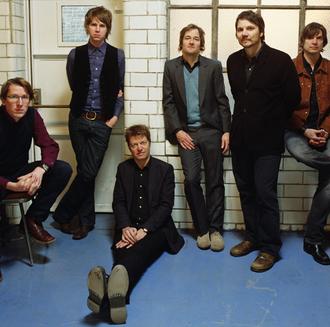
JULY/AUGUST 09 | WILCO: The Interview

Wilco

“Are you under the impression this isn’t your life?

Do you dabble in depression? Is someone twisting a knife in your back?

Are you being attacked? Wilco, Wilco will love you baby…”

The last time I saw Jeff Tweedy, he was giving a solo show in Burlington, Vermont. This was a few months ago. I crossed many states just to be there, and watch him perform, sans band, and cherry pick songs from his vast back catalog of my favorite music. He unveiled new songs like “Solitaire” and “Everlasting Everything,” and played a reconstituted “Spiders,” during which the audience of a few hundred sang in unison, “It’s good to be alone.” It was an amazing show, and well worth the drive.

I last interviewed Tweedy in 2004 for this magazine, when the Chicago-native had just gotten out of rehab to treat his addiction to pain killers and manage his panic disorder. The band was readying the release of A Ghost is Born, their ambitious follow-up to the career-defining Yankee Hotel Foxtrot. The road that lead them to Ghost was fraught with internal struggles and external victories—in 1995, Tweedy launched Wilco after an acrimonious split with Uncle Tupelo co-captain Jay Farrar, who went on to found Son Volt. Their first album, A.M., sold poorly in the shadow of Son Volt’s Trace, but was a solid debut, featuring alt.-country gem after alt.-country gem. The 1996 double album Being There increased their critical standing and remains a major work in rock and roll, a “Catcher in the Rye” for music lovers. Tweedy’s musical partner at this time was band multi-instrumentalist Jay Bennett, who helped Tweedy realize the pop-tastic visions of 1999’s Summerteeth and reach the avant-garde heights of 2001’s Yankee Hotel Foxtrot. But like all early Wilco members save bassist John Stirratt, Bennett (who sadly passes away this May) and the band eventually parted ways. His strained exit was captured in I Am Trying to Break Your Heart, which also documents the band’s struggle with their record company, Reprise, over Foxtrot’s commercial value—they would eventually leave the label for Nonesuch after Reprise squashed its release.

The story of Wilco 2.0 has been a fruitful one. The Ghost is Born tour introduced the world at large to new member Nels Cline, a guitar hero’s guitar hero. Their incendiary concerts were immortalized on the live album Kicking Television, and the band’s new musical rapport (from adding members Pat Sansone and Mikael Jorgensen to the lineup, which since 2001 has included the imaginative drum work of Glenn Kotche) was the highlight of last year’s Sky Blue Sky. Their new DVD, Ashes of American Flags, shows the band on the road, icing up, achieving lift off, and viewing the disappearance of small town America through their tour bus windows.

In June, they released their seventh LP, Wilco (The Album), the first record to feature the same lineup as the album before. With meditations on marriage and commitment (“One Wing,” “I’ll Fight”) a duet with Canadian singer/songwriter Feist (“You and I”) and some excellent rockers (“Bull Black Nova,” “Sonny Feeling”), it’s another great record from a band who seems incapable of making a bad one.

Jeff Tweedy in 2009 seems like a dude in a pretty good mood. He’d go on to rock Jazz Fest a few days after this interview, which would be the final show of a very long tour. We talked to Tweedy about Wilco (The Album), playing solo, and the spectre of “dad rock.”

When did you write the songs for this album?

Over the last year or so, since the last one come out. As opposed to the songs on the last record, which had been accumulating over the years, this one there’s really nothing that’s any older than Sky Blue Sky. I don’t think any of these songs were even around when we were recording Sky Blue Sky, so it’s a fresher batch.


What led you to record the record in New Zealand?

We went there and we were doing a benefit record with Neil Finn and the guys from Radiohead and Johnny Marr and we were having a great time and sounded really great in the studio, and Jim Scott was there with us, who had worked on our records before, and we did a little bit of recording, a little bit of demoing of different things. And we could get a lot of work done really quickly, because we were all set up and ready to go. When that project ended, we asked Neil Finn if he had anybody else coming into the studio for awhile, and if he had any open time, which he did, so we just stayed an extra nine days and knocked out the basics for almost the whole records.

Was it nice to record there?

Yeah, it’s a lovely place to stay, and I think the longest I ever stayed anywhere outside of the United States. So yeah, it got to be a home away from home, and for a large portion of that, my family lived with me, and Glenn and John’s families were there the whole time, and so it was a pretty lovely experience for everyone, really. Summer time there, it’s not summer time in Chicago, I can tell you that much.

How was it working with Feist on “You and I”?

It was great. She’s an amazing singer and a great friend. We got to be friends over the last year pretty quickly, and I have a lot of admiration for her and her records. So we were really glad that it worked out.

Did you spend a lot of time working on the lyrics to the songs, or was it more spur of the moment?

I spent a fair amount of time editing the lyrics and allowing the songs to kind of evolve. It’s a hard question to answer because anytime there’s anything worthwhile, it certainly “feels” like it happened on the spur of the moment, but it’s a composite of lots of spurs of the moment, hopefully. And over time, you catch up with those, and then you have full set of lyrics you’ve thought of and you feel comfortable singing.

I read that some of these songs were written in character.

I’ve always been sort of ambivalent about that approach to writing because I think it’s really hard to do, and I don’t think you every fully mask the person who’s writing; it usually comes through loud and clear, no matter how deeply into the third person you wanna get. But it’s something I’ve tried many times over the past few records, writing from different angles and perspectives, and sometimes it helps as a device to try to get a set of lyrics finished. But as it turned out, I thought this record ended up with more lyrics that used that approach than past records, in a character driven way.

What’s going on in “Bull Black Nova”? There’s a lot of blood in that song.

I don’t know what’s going on in that song. Well, nothing good is going on, I can tell you that. Except for the notion that however desperate to flee something that you wish you hadn’t done, you’re not going to be able to outrun it—so I guess that’s the moral of the story in that song. But I don’t know if I want to elaborate that much, at this point. It’s pretty there. [Laughs]

What’s the story behind “Wilco (The Song)”?

Initially, I thought it would be funny to write a song that sounded like an infomercial of some sort. I had other lyrics in the place of where I sing “Wilco” at one point, and I tried a lot of different things, but everything sounded too serious, including “let go,” “oh no,” and different things like that. I just kept coming back to “Wilco,” and that was certainly the most fun thing to sing when I was playing it for the other guys in the band. Eventually, it sounded silly to sing anything else, and it made the song a little funnier in our opinion.

Was that written for The Colbert Report or before?

We were playing around with it before The Colbert Report, and it seemed like it would be fun to play a song that wasn’t on any record and use the opportunity to play something that was exciting and new to us. Then all that Joe the Plumber crap started happening so we thought it would be funny to play “Wilco (The Song).”

It’s very catchy. I’ve been singing it all day in my head.

Could be worse, I guess. That’s sort of the unofficial motto for Wilco: could be worse.

The song “I’ll Fight” has some similarities to “On and On.” Do you agree?

Not that I hear, no, I don’t agree. I mean, I don’t doubt that it’s there, I’ve heard someone else say that, but musically, they’re very, very different, and emotionally they’re very, very different, so I don’t hear it. I mean, I hear there’s a repetitiveness in the choruses on the songs that are similar, but beyond that, I don’t think of them as being related. Other than, just as much as any songs I write are inherently related to each other.

In the song you sing “I’ll die like Jesus on the Cross,” How do you imagine that will play in different parts of the country?

I have no idea. First of all, I don’t know why it would be anything offensive to anybody, if that’s what you’re asking. It would never stop me even if I did think it was something offensive. I think from the character’s perspective, that’s definitely a noble way to die, for a principle. If somebody can’t understand that, they’re offended, interpreting the song with me equating myself with Jesus or whatever, that’s, as most is often is the case, based on their ignorance, and I have no sympathy for them.

Did you have a similar transformation to the one that you sing about in “Solitaire”?

Well, I mean, yes. I’ve definitely gone through a pretty major significant life change over the past couple of years. I think it’s pretty well-documented, and any healthier person who took a lot of pain killers, and was an addict, and struggled with those kind of things, I don’t know if you can have much more of a profound crossroads in your life than something like that. But having said that, I don’t know if that song is about that. I think it’s still sort of character-driven, in a way, I don’t know if I’m really singing from that experience. I never felt personally that I was “cold as gasoline,” so I can’t identify with that part of the song; except that I know people who I imagine to be able to look at the world without as much emotional upheaval as I tend to do.

With “You Never Know,” do those lyrics address your audience in a way?

Well, all lyrics address your audience. Every thing you write addresses the listener. So I don’t know if I know exactly what you mean. Am I telling our fans that, no [laughs]. No, it’s character-driven as well. Someone pretending to have a certain handle on things and that they don’t really have, when inevitably, you never know. It’s a pretty straightforward sentiment. In overwhelming evidence, you don’t ever know.

To read more of our interview with Jeff Tweedy of Wilco, click here to purchase the issue.

  • del.icio.us
  • Digg
  • Facebook
  • Google Bookmarks
  • StumbleUpon
  • Technorati
  • email
  • Yahoo! Buzz
  • Twitter
Article Tools Sponsor

Tagged as: , ,

Comments

  • mapa said:

    Great article. You seem to ask questions that no one else does. Makes for interesting reading instead of the same old stuff.

Trackbacks

There are no trackbacks